7 Signs There's Mold Behind Your Walls (No Demolition Needed)
The mold you can see is rarely the whole story. Here's how to tell what's happening inside your walls — using your senses, simple tools, and a few pro tricks.
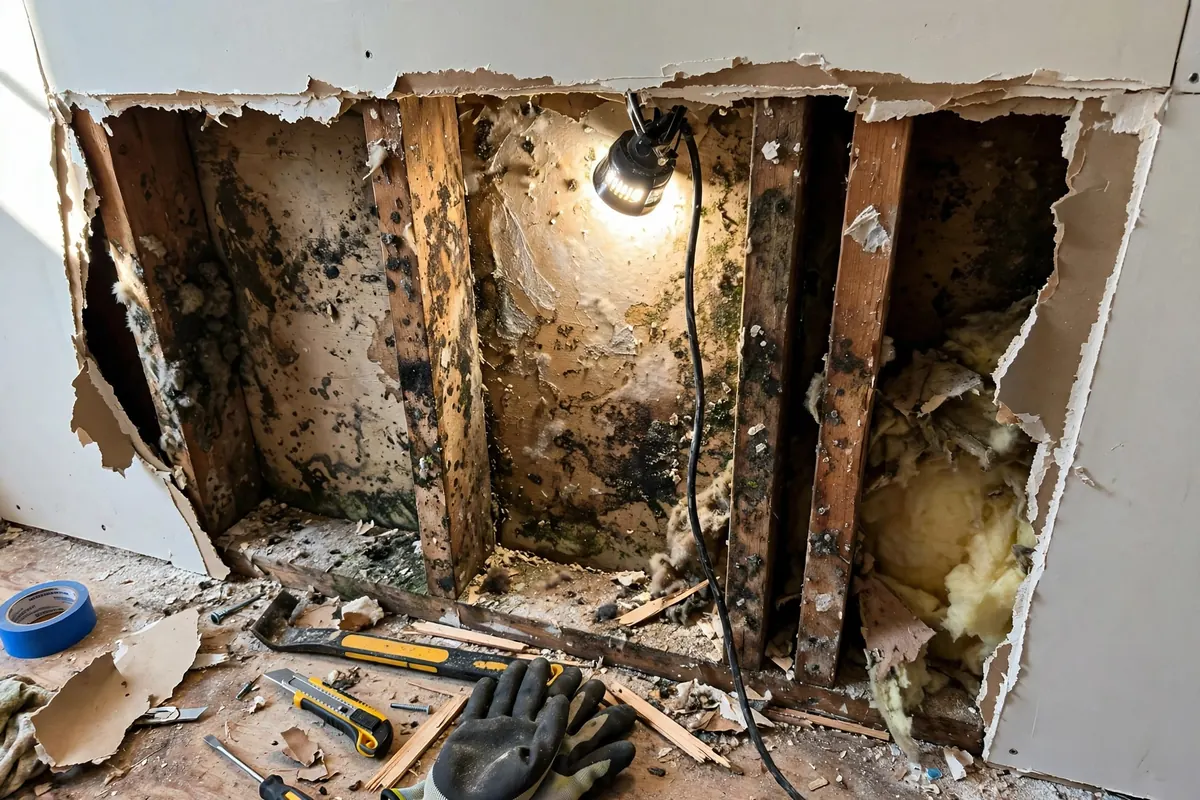
Walls are where mold hides best. A pinhole pipe leak, a bit of condensation inside the cavity, a roof drip running down a stud bay — the wall surface can look perfectly fine while the inside is a mess.
Before anyone starts cutting drywall, here's how to read the signs.
1. The Smell That Won't Quit
Your nose is the best early detector you own. Hidden mold produces a musty, earthy smell — like old books or a damp basement — that gets stronger in certain spots or at certain times (often when the heat kicks on and air moves through wall cavities).
Key test: close up the room for a few hours, then walk in and sniff near the walls. If one section smells distinctly mustier than the rest of the house, you're probably standing next to the problem.
2. What the Surface Tells You
Walls telegraph what's happening inside. Look for:
- Bubbling or peeling paint — moisture pushing out from behind
- Discoloration or staining — yellowish or brownish patches, even faint ones
- Warped baseboards — the bottom of the wall gets wet first
- Cold or damp-feeling spots — press your hand along the wall; damp drywall feels cooler
Any one of these alone might be nothing. Two or three together in the same area is a pattern.
3. The $30 Tool That Settles Arguments
A pin-type moisture meter costs about thirty bucks at any hardware store and takes the guesswork out. Press the pins into the drywall (in an inconspicuous spot) and read the number.
General rule: drywall reading under 1% is normal. Readings consistently above that — especially in one area while surrounding walls read normal — mean moisture is present, and where there's sustained moisture, mold usually follows. Compare suspect areas against a known-dry wall for your baseline.
4. Thermal Clues (Even Without a Camera)
Pros use thermal imaging cameras to see cold (damp) spots inside walls. You can approximate the idea: on a cold day, run your hand slowly along exterior walls. Noticeably colder patches can indicate missing insulation — or moisture, which also reads cold.
A cheap infrared thermometer ($20-30) works even better. Scan the wall in a grid pattern and note any spots reading several degrees colder than the rest. Cold doesn't prove mold, but it tells you where to point the moisture meter.
5. The Health Pattern
This one's indirect but real. If allergy-like symptoms — congestion, sneezing, itchy eyes, headaches — flare up in one part of the house and ease when you leave, hidden mold is worth suspecting. It's not diagnostic on its own (dust mites do the same thing), but combined with a musty smell in the same area, it's a strong signal.
6. Peek Behind Outlet Covers
This is the homeowner's borescope. Turn off the breaker, remove an outlet or switch cover on a suspect wall, and shine a flashlight into the gap around the electrical box. You can often see the inside face of the drywall and sometimes the stud bay itself.
Dark staining, fuzzy growth, or a strong musty puff when you pull the cover are all telltale. It's a five-minute check that has solved many mysteries.
7. What Pros Do: Borescope and Moisture Mapping
When we investigate, we drill a hole the size of a dime in an inconspicuous spot and feed in a borescope camera — we see inside the wall without opening it up. Combined with moisture mapping (meter readings across a grid), we can usually pinpoint the affected area within inches.
That precision matters: it means cutting a one-foot square instead of tearing down a whole wall. If your own checks point to a problem, a professional inspection is the step that turns suspicion into a plan.
When It's Time to Open Up
Open the wall when: the moisture meter confirms sustained wetness, you can see growth through an outlet gap, or the affected area is spreading. Don't open it on a hunch alone — every unnecessary hole is drywall repair you'll pay for. And when you do open it, contain the area first (plastic sheeting, and don't run the HVAC) so you don't spread spores through the house.